

There is nothing quite like the feeling of standing in an open field, your finger hovering over the launch controller button. The countdown begins—5, 4, 3, 2, 1—and with a sudden whoosh, your creation defies gravity, soaring hundreds of feet into the blue sky.
Model rocketry is an incredible hobby that blends creativity, physics, and pure adrenaline. But before you can enjoy that perfect flight, you need to understand the heart of your rocket: the engine.
If you have ever looked at a package of Estes engines, you might have felt like you were reading a secret language. What does "B6-4" actually mean? Why is a "C" engine bigger than an "A" engine? Is a higher number always better? These alphanumeric codes aren't just random labels. They are precise scientific formulas that tell you exactly how your rocket will perform.
We believe that understanding the science behind the whoosh makes the hobby even more fun. Let’s break down the Estes engine safety codes that every student should know so that you can launch with confidence and safety every single time.
Anatomy of an Engine Code
Every standard Estes engine has a code printed clearly on the side, usually consisting of a letter, a number, a dash, and a final number. A classic example is the B6-4.
To pick the safest engine for your specific model, you need to dissect these three distinct parts:
- The letter: total impulse (total power)
- The first number: average thrust (speed of fuel burn)
- The second number: time delay (coasting phase)
Let’s dive into what each of these means for your flight path.
The Letter: Total Impulse
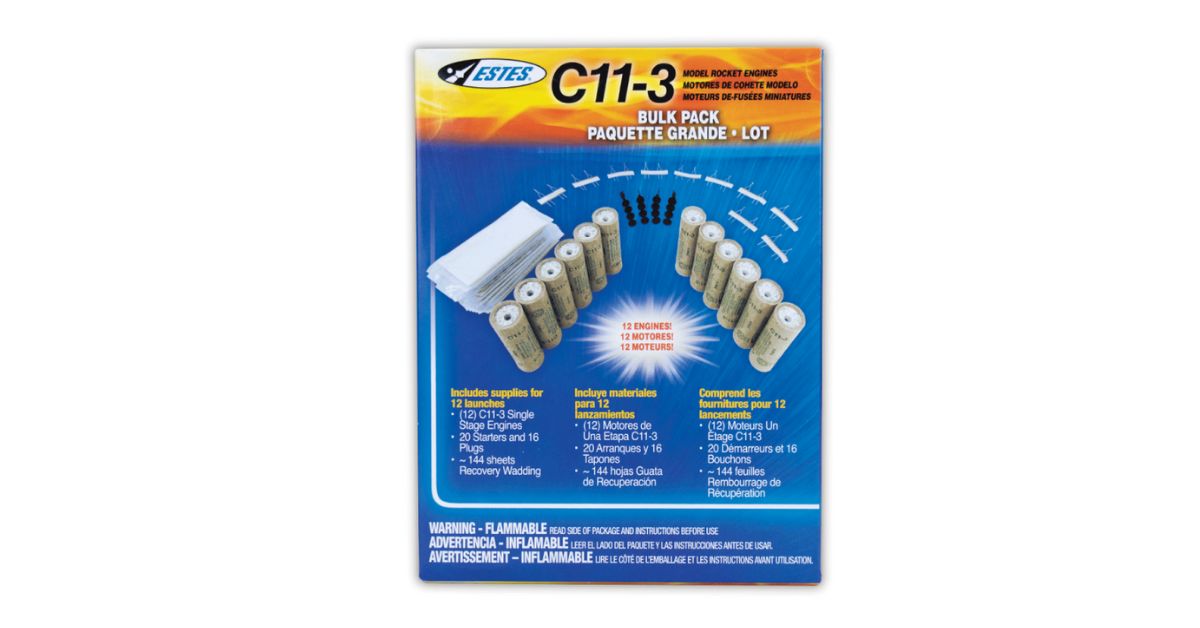
The first character in the code is always a letter (usually 1/2A, A, B, C, or D for standard student rockets). This letter indicates the total impulse, which is the total amount of energy or power packed into that engine.
Think of this as the size of the gas tank in a car. A larger tank means you have more energy available to get the vehicle moving.
The system is set up on a metric scale where each successive letter represents up to double the total power of the previous letter.
- A engine: the baseline for many beginner rockets
- B engine: twice the total power of an A engine
- C engine: twice the total power of a B engine (and four times an A)
- D engine: twice the power of a C
Safety Tip: Always check your rocket kit’s instructions for the recommended letter. Putting a high-power D engine in a tiny, lightweight rocket designed for an A engine can cause it to fly so high you never see it again (a common mistake!), or the structural stress could damage the fins.
The First Number: Average Thrust
Following the letter is a number, such as the 6 in our B6-4 example. This represents the average thrust measured in Newtons.
If the letter is the size of the gas tank, this number indicates how fast you are pressing the gas pedal. It tells you how quickly the rocket is releasing its energy.
- High number (e.g., B6): The fuel burns hot and fast. This provides a hard kick off the launch pad. These are great for heavier rockets that need a lot of initial thrust to overcome gravity and stabilize quickly.
- Low number (e.g., B4): The fuel burns more slowly and lasts longer. The rocket lifts off more gently but accelerates for a longer period. These are ideal for lighter, aerodynamic rockets that don't need a massive shove to get moving.
Safety tip: This is crucial for stability. Heavy rockets need high thrust to reach a safe speed before they leave the launch rod. If the thrust is too low, the rocket might flip over in the wind immediately after launch.
The Dash and Final Number: The Delay
Many rocket users misunderstand the last number following the dash, but it is critical for a safe recovery. In our B6-4 example, the 4 stands for seconds of delay.
Estes engines work in three stages:
- Lift-off: The propellant burns (thrust).
- Coasting: The engine burns a smoke tracking charge but produces no thrust (delay).
- Ejection: A small charge fires to pop the nose cone and deploy the parachute.
The delay number tells you how long the rocket will coast after the fuel runs out but before the parachute pops. You want the parachute to deploy exactly at apogee—the highest point of the flight where the rocket naturally slows to a stop before falling back down.
- Short delay (e.g., -2): Best for heavy rockets that don't coast very far upward after the fuel is gone.
- Long delay (e.g., -6 or -7): Best for light, streamlined rockets that will keep coasting upward for a long time.
Safety Tip: If you use a long delay on a heavy rocket, gravity will take over before the parachute opens. The rocket will arc over and start diving toward the ground at high speed. If the parachute opens while the rocket is diving fast, the shock cord can snap, or the chute can rip (a phenomenon known as "zippering" the body tube).
Special Codes: 0 and P
Occasionally, you might see codes ending in a zero (e.g., C6-0) or a P (e.g., B6-P). These are for advanced multi-stage or glider rockets.
- "-0" (booster engines): These have zero delay and no ejection charge. Instead, they open at the top to allow hot particles to rise and ignite a second engine immediately. Never use a -0 engine in a standard single-stage rocket, or it will crash without deploying a parachute!
- "-P" (plugged engines): Many people use these plugged engines for rocket gliders or vehicles that do not need a parachute ejection. The caps prevent hot gas from escaping forward.
Why Following Recommendations Matters
Every model rocket kit you buy comes with a list of recommended engines. These aren't just suggestions; they are safety requirements based on the weight and aerodynamics of that specific model.
When you are a student learning the ropes, stick to these recommendations. The engineers have done the math to ensure the engine has enough thrust to safely lift the rocket off the pad, but not so much power that it becomes dangerous or unrecoverable.
Once you understand the code—power, thrust, and delay—you can start to make educated choices based on your flying field size and wind conditions.
Ready for Liftoff?
Learning Estes safety codes is imperative for every student, whether novice or expert. Safety is the key to enjoyment. When you equip your rocket with the right power, the right thrust, and the perfect delay, you can relax and enjoy the spectacle of the flight.
At AC Supply, we offer Estes rocket engines for every young scientist. Whether you’re looking for standard rocket engines or minis, we have everything you need for your next launch. So, grab your launch pad, check your codes, and get ready to touch the sky!