
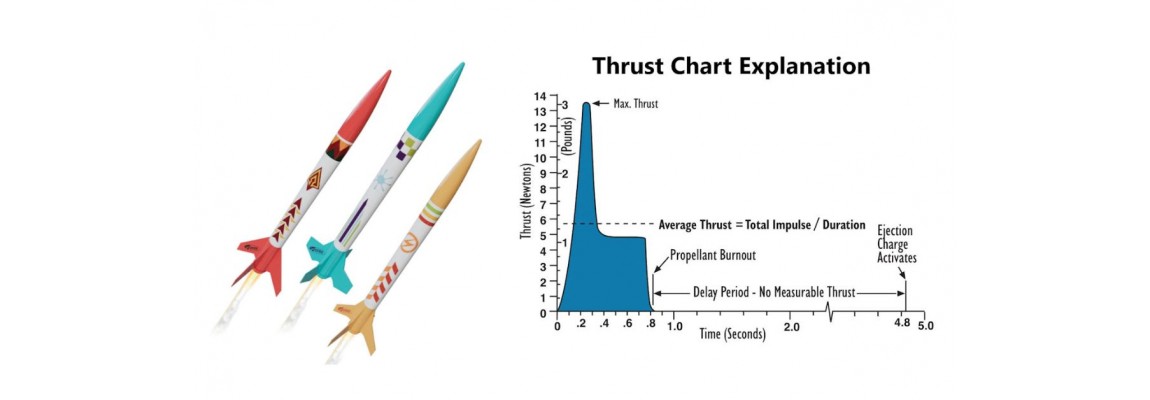

Have you ever stared at an Estes rocket engine package and wondered what those mysterious squiggly lines and numbers really mean? Those thrust curve charts aren't just decorative—they're your roadmap to understanding exactly how your rocket will perform during flight.
Understanding how to read Estes engine thrust curves charts is essential for selecting the right engine for your rocket, predicting flight performance, and most importantly, ensuring safe launches that will keep both you and your young copilots excited about model rocketry for years to come.
What Is a Thrust Curve Chart?
A thrust curve chart is a graph that shows how much force (thrust) an engine produces over time during its burn. Think of it as a snapshot of your engine's personality—some engines are sprinters that deliver quick bursts of power, while others are marathon runners that provide steady thrust over longer periods.
The horizontal axis represents time in seconds, while the vertical axis shows thrust measured in Newtons (N) or pounds-force (lbf). The area under the curve tells you the total impulse—essentially the total amount of “push” your engine will deliver to lift your rocket skyward.
Every Estes engine comes with this chart printed right on the package, giving you valuable insights before you even light the fuse. It's like having a preview of the exciting ride your rocket is about to take.
Breaking Down the Key Components
To understand how the Estes engine will affect your launch, you need to have a firm grasp of what to expect from each component.
Peak Thrust
The highest point on your curve represents peak thrust—the maximum force your engine will produce. This typically occurs within the first fraction of a second after ignition. Peak thrust determines how quickly your rocket will accelerate off the launch pad and is crucial for heavier rockets that need extra oomph to get moving.
For family projects, engines with moderate peak thrust (around 5–15 Newtons) provide exciting launches without being overwhelming for younger rocketeers watching their creations soar.
Burn Time
The total width of the curve shows burn time—how long your engine will produce thrust. These engines typically burn for 1–3 seconds, though this varies significantly between engine types. Longer burn times generally mean higher altitudes, as your rocket continues accelerating for a longer period.
Average Thrust
While peak thrust grabs attention, average thrust often matters more for overall performance. This is the steady force your engine maintains throughout most of its burn. You can estimate average thrust by looking at the general height of the curve's middle section.
Total Impulse
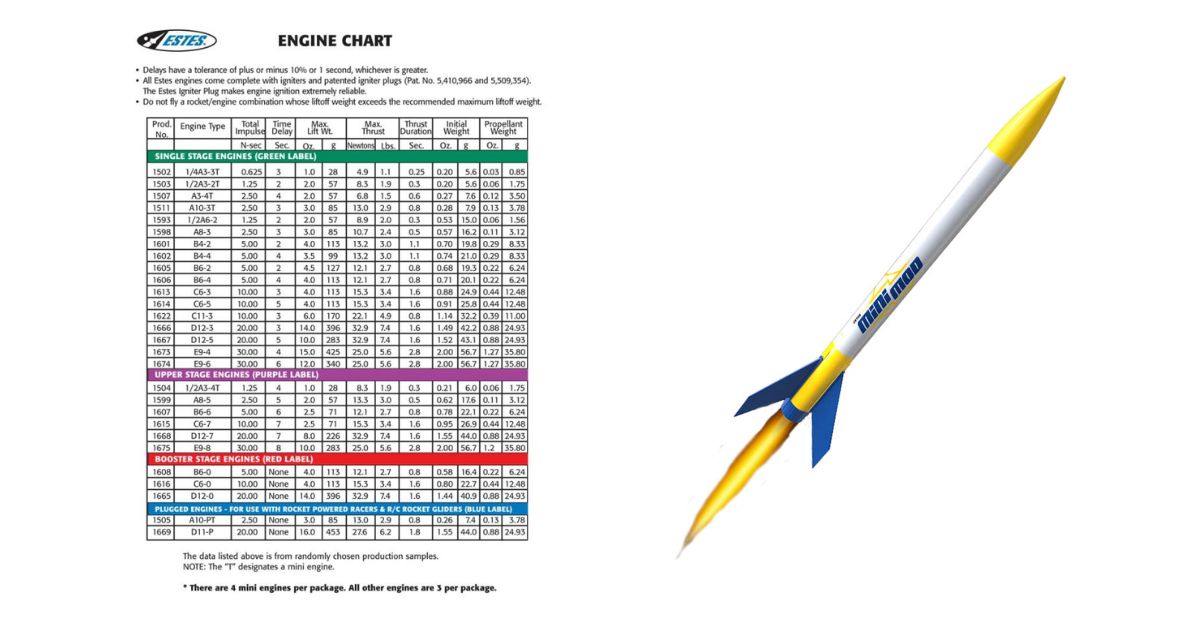
The total area under the curve represents total impulse, measured in Newton-seconds (N⋅s). This number appears in your engine's classification code—for example, a B6-4 engine falls within the B impulse class, delivering between 2.5 and 5.0 N⋅s of total impulse.
Decoding Common Estes Engine Patterns
The different Estes engine patterns can be confusing to novices. Below are a few common ones that you might see on your next engine.
The Classic Bell Curve (A8-3, B6-4, C6-7)
Most standard Estes engines produce a bell-shaped curve with quick startup, peak thrust within the first half-second, then gradual tapering. These engines are perfect for beginners and provide predictable, reliable performance that's ideal for family launches.
The Plateau Profile (D12-5, E9-6)
Higher-power engines often show a more rectangular profile, maintaining steady thrust for longer periods. These engines provide sustained acceleration, making them perfect for heavier rockets or when you want to reach maximum altitude.
The Quick Burst (1/2A3-4T)
Smaller engines designed for lightweight rockets show sharp, narrow curves. They deliver their energy quickly and are perfect for small rockets that need just enough push to reach respectable heights without overpowering delicate airframes.
Reading Engine Codes Alongside Thrust Curves
Estes uses a standardized coding system that works hand in hand with thrust curves. Take a B6-4 engine: the “B” indicates total impulse class, “6” represents average thrust in Newtons, and “4” shows the delay time in seconds before the recovery system deploys.
When you match this code with the thrust curve, you can predict exactly how your rocket will behave. A B6-4 with its characteristic bell curve will provide quick acceleration off the pad, coast upward for about 4 seconds after burnout, then deploy the recovery system at apogee.
Matching Engines to Your Rocket Projects
Every young rocket launcher wants to see the biggest takeoff possible, but you should focus on rocket projects that work well for their age. Different rockets will work better for various age groups and keep the kids engaged throughout the prep and launch.
For Lightweight Beginner Rockets
Choose engines with moderate peak thrust and shorter burn times (A8-3, B4-4). These provide exciting flights without overwhelming small rockets or young builders. The thrust curves for these engines show gentle acceleration that's perfect for first flights.
For Mid-Power Family Projects
Step up to B6-4 or C6-7 engines when building larger rockets with your kids. Their thrust curves show more dramatic acceleration and longer burn times, delivering impressive altitude gains that will have everyone cheering.
For Advanced Parent-Child Collaborations
D and E class engines open up the possibility of serious altitude attempts. Their flatter, more sustained thrust curves mean rockets continue accelerating longer, perfect for ambitious projects where you're pushing the boundaries together.

Safety Considerations When Reading Charts
Understanding thrust curves isn't just about performance—it's about safety. High-peak-thrust engines can damage lightweight rockets, while underpowered engines might not safely lift heavy payloads off the pad.
Always match your engine's characteristics to your rocket's specifications. Most kit instructions recommend specific engines, and their thrust curves explain why certain combinations work better than others.
Using Thrust Data for Flight Predictions
Once you understand thrust curves, you can make educated guesses about flight performance. Engines with higher total impulse generally mean higher altitudes, while those with sustained thrust profiles often provide better altitude than engines with sharp peak thrusts of similar total impulse.
This knowledge helps you choose the right engine for your desired flight experience. Want a quick, exciting flight for younger kids? Choose an engine with high peak thrust and shorter burn time. Prefer a longer, more dramatic ascent? Look for engines with sustained thrust profiles.
Building Confidence Through Understanding
Learning to read thrust curves transforms rocket selection from guesswork into informed decision-making. You'll find yourself confidently choosing engines based on what you want to achieve rather than randomly grabbing whatever's available.
This understanding enhances the educational value of model rocketry, turning each launch into a practical physics lesson. Kids love seeing how the squiggly lines on the package translate into real rocket performance, connecting theory to exciting reality.
Taking Your Rocketry Knowledge Further
Reading Estes engine thrust curves is just the beginning of a deeper understanding of rocketry. These charts connect to concepts like momentum, acceleration, and energy conservation—all perfect topics for curious minds to explore further.
Ready to launch your rocket? Head over to AC Supply and find the right Estes rocket engines for your project. Once you have your next rocket project, you and your little copilot can reach for the stars!